Once Something is Finished it Becomes Dull
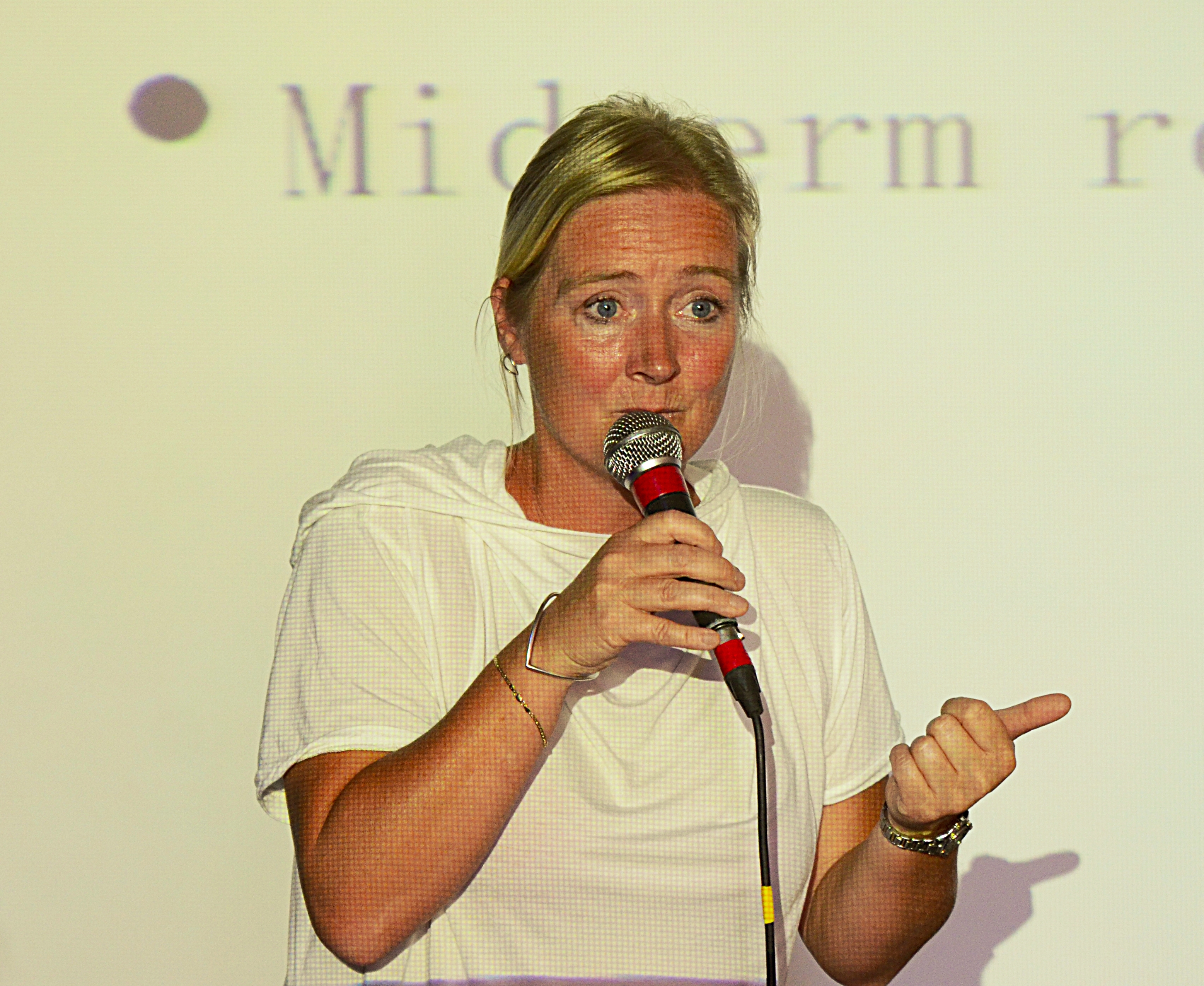
Interview with Anne-Marie Hoogland, Director of NDSM Wharf Foundation.
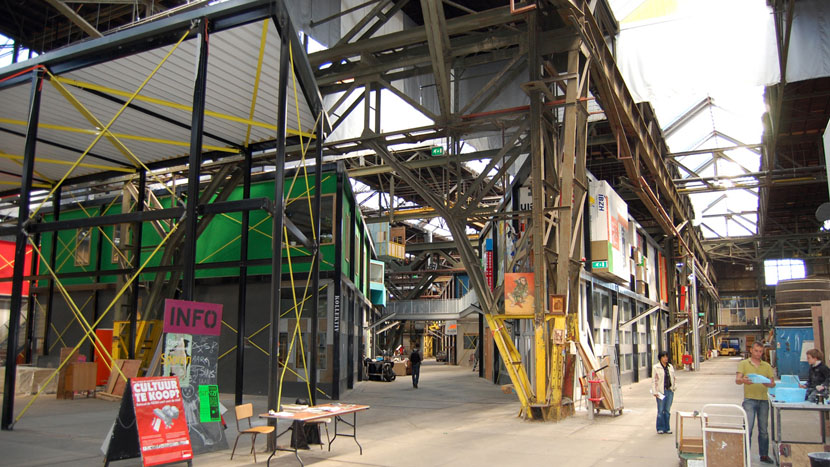
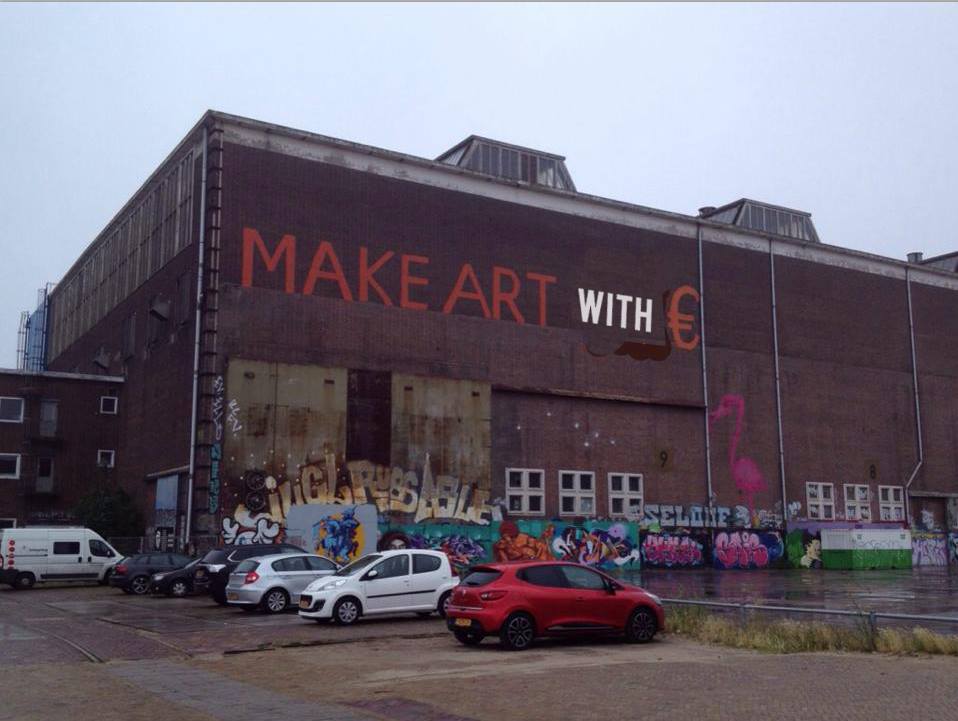
NDSM (Nederlandsche Dok en Scheepsbouw Maatschappij) – a gigantic industrial area of the former shipyards located across the IJ river at Amsterdam North. In the 1990s, after the port industry moved farther seaward, the disused territory and huge industrial buildings had become an alternative place of expression for artists. In 2013, Amsterdam municipality, the owner of the land, initiated a new program intended for its development created by NDSM Wharf Foundation. Its director Anne-Marie Hoogland says that this place, as the former shipyard and the current cultural epicentre, needed for creating a new vision or history for the future, because, as their motto says “Once something is finished it becomes dull”.
Interviewed by: Martynas Mankus and Aida Štelbienė.
 Former NDSM.
NDSM shipyard as an example has been mentioned in all textbooks about the city pioneers and urbanistic catalysts and breeding places. Sometimes it is referred to as Europe’s largest cultural incubator, the main cultural site in Amsterdam, the best example of the Dutch urban regeneration. Could you briefly remind the history of NDSM?
In the 1990s the northern part of Amsterdam’s government decided to hold a design contest under the name of “City of Art” (Kunststoff). The wording “City of Art” was not yet made-up at that time, the tender specifications simply requested creating something in a huge building. There was a great number of submitted projects. Eva de Clerk together with her affinity group has established a movement the goal of which was to set up small studios and to clean up the building and its surroundings. In this very territory several major events were organized, for example “Dogtroep”, performances of extremely bright theatre artists’ troupe. The audience represented the people following innovations. In this way in the mid-1990s something new had started emerging. Later on, the city of pioneers, artists, entrepreneurs active in the area established Kinetic North Foundation (Stichting Kinetisch Noord) winning “City of Art” development competition. From the municipality they got subsidies for creation of the organizational structure. It was planned that the foundation will become the owner of the building and will have the authority to lease the premises, whereas artists will invest in setting up these facilities. There were also projects on investing to the clean-up of external environment. However, in 2009 the foundation could not remain fully operational, as back then people from municipalities were pretty much involved in the organization of processes; the city administration used to delegate its own officials to help managing this small foundation. It also became difficult to collect rent on artists’ studios, consequently the artists’ community, the project developer and the local authority had decided to take action. In 2009 a new foundation started functioning – over half-year it brought together a small team of two permanent and fifteen freelance employees.
 Art City
What are the current relations between the two foundations?
Our cooperation is close. There is an “external” foundation – “NDSM wharf” – and “internal” foundation – “Kinetic North”, which at the same time is a laboratory as well (Breeding place). The latter foundation aimed to become the owner of the NDSM building. That happened a year ago. The foundation also plans independent repair works of the building – the walls and the roof.
What would you say about the temporality aspect in the development of NDSM? Have you agreed on temporary use, or have you concluded a contract of permanent land lease?
Currently, we have a well-established contract. In 2012, the municipality decided to invest in this region and to support its development as it is of a great importance to invest in infrastructure for future construction already today. These are significant investments – water-supply, sewer, gas, electrical power grids are needed. The municipality simultaneously developed the plans of both the eastern and western parts of the NDSM territory. Afterwards, a member of Amsterdam city council responsible for the development of urban areas went for inspection of these areas. He and his assistants decided which fields needed further development and which ones requested a slow-down. In NDSM shipyard, it was decided to confine the development of the eastern part, while the western part would be subject to further development. The western part had been authorized to construct residential houses according to a detailed plan, whereas in the east only the reconstruction of the old industrial buildings was allowed. We, as the foundation operating in this area, had perceived that a different development will create an imbalance between these territories. We see the shipyard as an integral whole, a one-piece area, that’s exactly why we began creating its vision for the future.
You’ve mentioned that the founders of the foundation are three partners: the municipality, artists and private companies. What are the interests of private developers?
The project involves one company, it develops the western part. It has also invested into the reconstruction of the industrial buildings located in the eastern part of the territory and has successfully sold them to investment companies.
So it is obvious that you provided added value for the developer.
Yes, the value of the district keeps growing. Once a housing development is planned, people start talking that it is a hotspot of the city interesting to live in.
 NDSM area now.
Is there no possible risk that the foundation that has contributed to the development of the regional identity at some point be pushed out?
Our operating contract is in force until 2019. The cultural agreement with the project developer is valid until 2022. One of the annexes to these agreements is a vision created by us. Yesterday (during the opening event of the Aukštamiestis workshop), I was asked why we create a vision after the approval of territorial planning solutions. Yes, it’s a different way, but we do now have a vision. So at this moment the vision as a mandatory annex is being included into each concluded agreement. Let’s say, if a new agreement on cultural tax with a project developer is being prepared, one of its components is the development in line with this vision …
…while making attempts to formalize and include it in the planning documents?
Not quite, as the planning documents have already been prepared! For example, I’ve included the vision into the agreement on cultural tax that was renewed last year. We recorded it in interim reports. We incorporate it to the assessment process of operating contracts. But back to your question, this is business, and that is the risk of every businessman – if you are no longer capable of selling your services, it means you have come to an end. Therefore, our foundation must constantly look for innovative ways in what we do, how we operate and how we unite the community with the help of our work.
What kind of instructions you are trying to include into the documentation?
Nine reference points . We proceed with the meetings of “Self-Developed Future” and according to them we draw up agendas. One of our developed projects that was launched last December was the initiative of a sustainable shipyard development. We have the possibility to provide festivals organized in our territory with green electricity. Nowadays, all festivals are powered by diesel generators polluting the environment and causing a lot of noise and dust. In March of the next year during the oncoming festival the whole area will be equipped with green energy. Another initiative is related with artistic projects. For example, next year most likely we be able to welcome Atelier Van Lieshout artistic project from Rotterdam which will create an installation specially designed for NDSM shipyard.
The most difficult task is to forecast which one of the new real estate is going to be developed and what kind of people will come to live in the shipyard. Presently, one of the most inspiring challenges is to find a way of making influence on decision-making and development, bearing in mind the fact that we as the foundation are neither landowners nor the developers. Yes, without having leverage, we still have to influence the municipality and the developer with the aim to do something special and create a block completely different than the surrounding territories.
Cultural activities here attract artists, enterpreneurs, creative class, etc. Since the northern part of Amsterdam has historically been the workers’ district, the question arises – how do you cope with the problem of gentrification?
Pessimists would offer to refrain from dealing with gentrification; it will prevail anyway. Optimists would choose the light version of gentrification, the way I’m seeing the development. We must have the ten-year future vision acceptable for all. This experimental Amsterdam district can become an exciting place only in case cultural industry, people of culture and cultural community will be allowed to be present here. For example, Kinetic North Foundation can offer 250 studios as a low-cost space for work. It costs about 50-60 euros per square meter, which is affordable and is quite cheap for this district.
But what about people living in the surrounding districts, indirectly in NDSM territory? Maybe you’ve got programs specially designed for them?
Many people from the neighbouring districts come to the shipyard, they go to restaurants, come to public events and so on. We have also established a temporary museum under the name NDSM Revisited. This is a project dedicated to former shipyard workers, who are now 60-70 years old. They collect and store the shipyard exhibits and showcase them for the public. This is one of the projects developed by us, and these people are also invited to the meetings of “Self-Developed Future”. When organizing festivals, we invite people with low income.
 Art City
Do organizations with the bottom-up approach usually related with alternative subcultures have the skills for developing projects independently? Or maybe they are doomed to fail?
Despite the arising problems it cannot be said that bottom-up movements are not aware of how to manage the foundation or function as the owner or ideological leader of a gigantic building housing 250 artists. It would be too easy to say so. “City of Art” was a huge success. This part of Amsterdam is much talked about; people enjoy what’s going on here. Naturally, you can always strive for more, however being an optimist like me, I believe that we have a perfect work environment. A lot of free time was devoted for the project, a great deal of support came from active citizens, artists, mothers with children, roller-skaters. They didn’t get paid for that, however all of this has brought it an awful lot of “kinetic” energy.
What is your opinion about the role of the municipality, does it help you? Or maybe it simply tries to shake their functions off as taking care of the territory, operating and developing it is they direct job? Maybe transferring the initiative to artists is not that much handy for it?
Local authority is one of our best and closest partners, as well as investment-wise. I understand that we as the foundation are doing a great favour for government agencies. We contribute to increasing the value of the territory, but it is exactly what we get paid for. We are able to keep seven employees as well as develop projects. Moreover, the municipality allows us during the upcoming festival to rent parking lots owned by it, which would result in additional revenue for us.
All cultural and social value that has been created by you may suddenly become just a simple commercial value. Is there any way of preserving the cultural aspect?
As we look to the future – if part of income earned from the commercial activity in the territory comes to us, we can say that we will be able to introduce innovations, to continue developing programs and engage in land rent. In this way we could proceed in meeting objectives. We need to develop a strategy that would involve the future residents of the shipyard territory, and it is one of the challenges for the upcoming years.

Do artists coming to work in NDSM take into account the identity of the shipyard? Or do they simply ignore it?
I believe, it happens in either way. Even before the establishment of foundations one of the most renowned art events in the shipyard was organized by “Dogtroep” group. It was a performance specifically designed for the shipyard territory – it used water, cranes and lights. Another initiative was “Robodock” – the festival loaded with fire, wind and metal, something like “Burning Man”. These events carry an artistic content, in my opinion, they correlate with the territory’s context and atmosphere which is characterized as brutish and powerful. Our vision also takes into account the history of the territory. We wish that this site would continue maintaining the image of the shipyard, and there would be enough space for industrial elements.
In Vilnius, unlike in Amsterdam, most of the real estate has been privatized. The municipality most likely may be interested in the development of Aukštamiestis territory as an important cultural part of the city, however it owns a very small part of the real estate.
I’m not sure what it’s like in Vilnius, however Amsterdam’s municipality is responsible for supervision of all public spaces and maintenance of their quality. While developing offices and residential buildings, high-quality public spaces simultanesouly increase their attractiveness. Aukštamiestis community would like to develop the territory as a cultural part of the city, like analogue of the Old Town providing the city with more diversity. The municipality could and should take care of investments in public spaces, whereas business representatives will become interested in the opportunity to develop this area. That could serve as an agreement, and that would give synergy. If this process became successful, it would attract tourists, young entrepreneurs and creative people. It seems to me very logical and realistic to establish a relevant organization, to develop a strategy, to plan the whole process and to find investors. If the municipality approved the budget for the management of public spaces, the process could get launched in four years. For me acting as the mayor of Amsterdam Westerpark District it took four years for the preparation of the development plans and four years for implementing them. Property owners renovated the buildings after the municipality had taken care of qualitative public spaces with attractive playgrounds, beautiful parks and lovely streets. It also reinforced social infrastructure – spaces for children and teenagers. Local traders received the support as well. I’ve gain such experience and I’ve seen the park and residential districts chage. For this purpose the organizations has been established.
What are your impressions after visiting to Vilnius district Aukštamiestis? Do you envisage any potential in “Loft” territory?
I’ve never been here before. We landed in a really small airport, we took a taxi to a hotel, then went straight to “Loft” in Aukštamiestis. But what I actually wanted to see was the Old Town. I had to get an idea about the best part of the town as I was certain that I got to experience the worst one. I wanted to see the high quality and get the impression of what is “high” and what is “quality” in Vilnius. I’m really impressed of what I saw. So, in my opinion, in Vilnius you’ve got a point of reference characterising high standards, high quality, what is interesting and lively. Of course, I could not assess the social impact, income level, sociality. As for Aukštamiestis territory, if the mayor knows and loves his city, he should concentrate on the neighbourhoods surrounding the Old City. With such ambitions he could start launching projects as an authority representative, as a promoter of a new development. The new development should be a modern process during which people would assume responsibility, would have a common vision and a coordinated development project that would enable creating a prosperous district.
NDSM infor.
WORK on the WHARF in nine reference points (Laboratory NDSM wharf program, course 2014–2025):
1. The shipyard is a laboratory. Here we strive to make connections, with any and everyone at every level.
2. What Amsterdam-Zuidas is for the world of finance, the wharf must become for creation, culture and urban development.
3. The wharf is one and indivisible. In other words, not: ‘living in west, art in east, and sports on the water”, but cross-pollination every way.
4. An experimental approach to the wharf also implies a search for the best form of (self)organization.
5. With our motto ‘The wharf, that’s you’ we program the wharf with festivals and events that are sustainable and technically innovative.
6. Common sense where possible, rules where necessary. However, it must the rules that serve the wharf community.
7. Silence is for residential areas and museums. Not for the wharf, where tumult and peace alternate each other.
8. The wharf quite literally reflects the history of building of colossal ships, and that has to remain recognizable.
9. The space of the wharf is dear for us, the physical as well as mental space. It’s a “terrain vague” (“no man’s land”), a hotchpotch of old and new, monumental and shabby, beautiful and ugly. And that is just fine.